This report is trending because it directly addresses the economic realities and growing income disparity many Koreans feel. It resonates with the struggles of the average worker, especially when contrasted with news of large corporate bonuses.
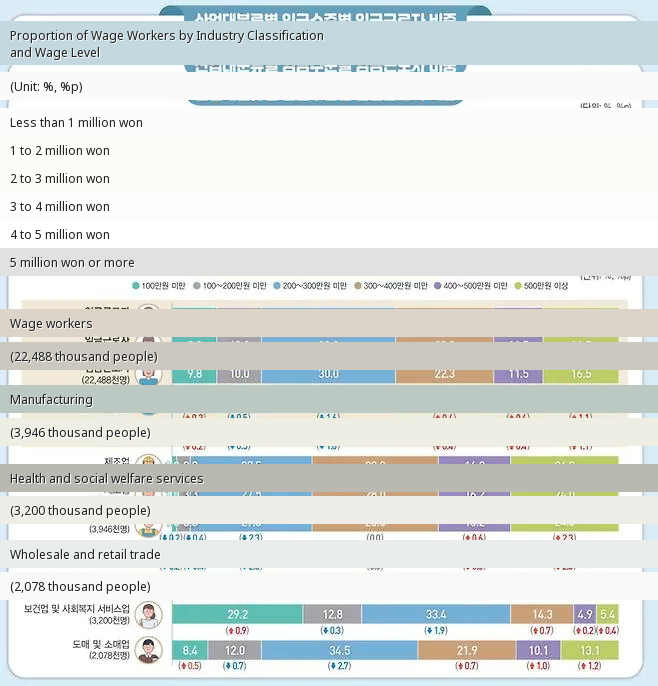
A recent report from South Korea's National Data Agency is sparking conversations online, revealing a stark reality for many Korean workers: three out of ten wage earners are taking home a monthly salary in the ₩2 million range (approximately $1,500-$1,600 USD). This data, from the '2025 H2 Regional Employment Survey,' highlights a significant income disparity, especially when news of 'bonus feasts' (성과급 잔치) at major corporations often dominates headlines.
While the proportion of workers in the ₩2-3 million won bracket slightly decreased by 1.6 percentage points from the previous year, it still remains the largest segment at 30% of all 22.488 million wage earners. Meanwhile, higher income brackets are seeing more substantial growth. Those earning ₩5 million won or more (around $3,800+ USD) saw their share increase by 1.1 percentage points, compared to smaller gains in the ₩3-4 million and ₩4-5 million won ranges.
The report also sheds light on significant wage gaps across industries. Nearly half (47%) of workers in the accommodation and food services sector earn less than ₩2 million won a month, placing a large portion of them in the low-income category. Similarly, health and social welfare services, agriculture, and arts/sports/leisure industries also show a high concentration of low-wage earners. In stark contrast, high-paying sectors like finance and insurance (38% earning ₩5 million+), and professional, scientific, and technical services (35.8% earning ₩5 million+) are thriving, alongside a growing high-income segment in manufacturing, which includes many of Korea's major export companies. This data paints a clear picture of a widening gap between the 'haves' and 'have-nots' in the Korean job market.
🇰🇷 KOREAN REACTIONS 3
What's a bonus? Asking for a friend... (aka me lol)
This article probably won't sit well with those who preach about equal welfare.
Nothing wrong with this in a capitalist society, right?