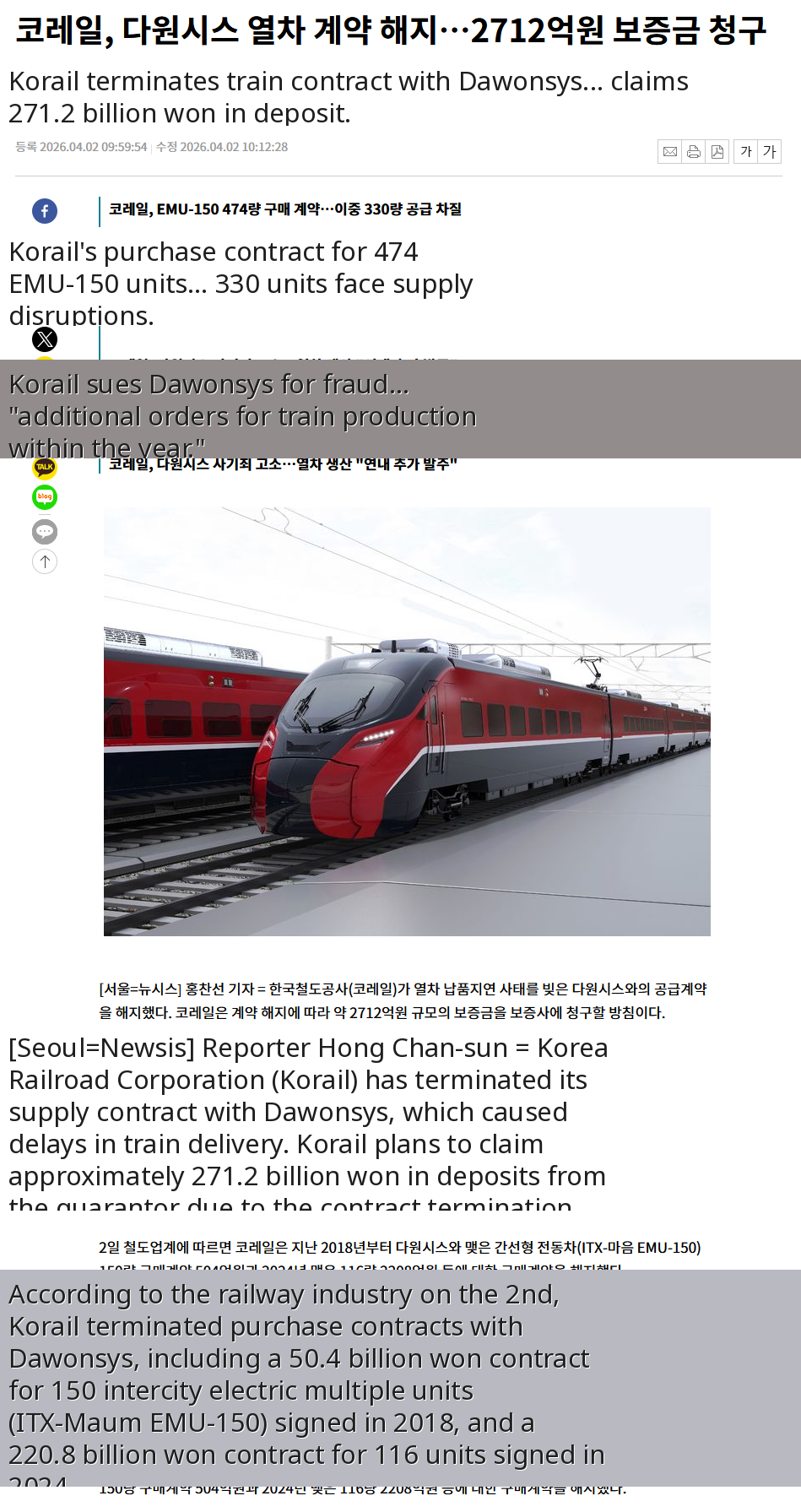
Dawonsys' bankruptcy and the termination of its contract to build new Mugunghwa trains have gone viral, exposing the critical failures of Korea's "lowest bid" public procurement system, which led to shoddy quality and financial mismanagement in a vital public service.
Korean netizens are up in arms over the recent collapse of Dawonsys, a major railway rolling stock manufacturer, whose bankruptcy and contract termination by national operator Korail have exposed deep-seated flaws in the country's public procurement system. Dawonsys, responsible for producing new Mugunghwa trains, now faces stock trading suspension and delisting, leaving many wondering how a critical infrastructure supplier could fall so spectacularly.
The company's downfall is a classic tale of the "lowest bid system" gone wrong. Dawonsys reportedly thrived by consistently winning contracts with rock-bottom bids, only to find itself without sufficient funds to actually produce the trains. This led to a desperate cycle, often referred to as "ta-kkap-dwae" (따갚되) – winning new contracts and using the advance payments to partially fulfill older obligations, a precarious balancing act that eventually crumbled when new orders dried up.
Adding insult to injury, despite policies designed to protect domestic industry by blocking Chinese competitors, Dawonsys allegedly resorted to assembling trains with Chinese-made parts. The quality issues were legendary: new electric trains reportedly suffered from cracked cockpit windows on as many as ten different sets! This shocking revelation has sparked outrage, highlighting not just corporate mismanagement but also a systemic failure to ensure public safety. Korail is now scrambling to find a new manufacturer, but experts predict it will take years, meaning Korea's aging Mugunghwa trains, many already past their operational lifespan, will continue to chug along for the foreseeable future. This whole debacle has ignited a fierce debate online about the urgent need to reform Korea's public bidding practices.
🇰🇷 KOREAN REACTIONS 10
The lowest bid system always causes this kind of mess. Audits are just for show, too.
I heard a bunch of retired Korail execs and Ministry of Land staff went to work for that company. Cut all their pensions!
Wait, why did I remember this company being involved in nuclear fusion?
Fusion train lol.
It's true, they have patents for tritium storage for fusion. But the funny thing is, only one place (JET) has ever done permanent tritium fusion experiments globally. Radiation issues make it super tough to handle. I thought the Dawonsys CEO, being from KAIST, would do well in that field, but... well, here we are.
If you don't buy the cheapest option, the person in charge gets audited and heavily disciplined. It's a no-win situation for public officials.
Thanks to them, the company that guaranteed their loans is also on the verge of collapse lol.
They even built a new HQ during all this, didn't they? Last public disclosure said it was a 70 billion KRW investment.
Only the company goes bankrupt, not the CEO...
Shareholders are totally screwed ㅠ.